Go to main content

Summer Historical Reenactments in Tuscany

Parades, games, challenges and costume parties to relive the history of villages and towns

There are places in Tuscany where history isn't confined to palaces, archives, and museums, but returns to fill the squares and streets.
This happens especially in summer, when villages and towns change their pace and come alive with parades, competitions, ceremonies, historical costumes and ancient rituals.
It’s not just about watching a show, but about entering a collective dimension, built around traditions that continue to engage residents and visitors alike.
Through competitions between districts, historical games and reenactments, the past becomes a living part of the present.

Contents
  • 1.
    Calcio storico fiorentino
  • 2.
    Gioco del Ponte in Pisa
  • 3.
    Giostra dell’Orso in Pistoia
  • 4.
    Palio della Balestra in Sansepolcro
  • 5.
    Palio del Cerro in Cerreto Guidi
  • 6.
    La Notte di Isabella in Cerreto Guidi
  • 7.
    Monteriggioni di Torri si Corona
  • 8.
    Bravìo delle Botti in Montepulciano
  • 9.
    Montopoli Medioevo
  • 10.
    Cutigliano Medievale
1.

Calcio storico fiorentino

Image of the game showing the players performing acrobatic moves in the center of the field
Calcio Storico Fiorentino - Credit: Comune di Firenze

In June, Piazza Santa Croce hosts Calcio Storico Fiorentino, a ball game dating back to the Middle Ages and one of the most spectacular traditions in Florence.
Competing for victory are the teams representing the four historic districts: the Bianchi di Santo Spirito (White team), the Azzurri di Santa Croce (Blue team), the Rossi di Santa Maria Novella (Red team) and the Verdi di San Giovanni (Green team).

Each team is made up of 27 players and the matches last about fifty minutes. The game, also known as calcio in livrea or calcio in costume, combines strength, strategy and possession of the ball: the goal is to reach the far end of the opponent’s area and score a goal.

The earliest reliable records date back to the 16th century, while its origins may be linked to the game of Harpastum. The tournament includes two semifinals and the final on June 24, the day celebrating St. John, patron saint of Florence. The day features a parade in historical costume through the streets of the city center and ends with fireworks.

1.

Gioco del Ponte in Pisa

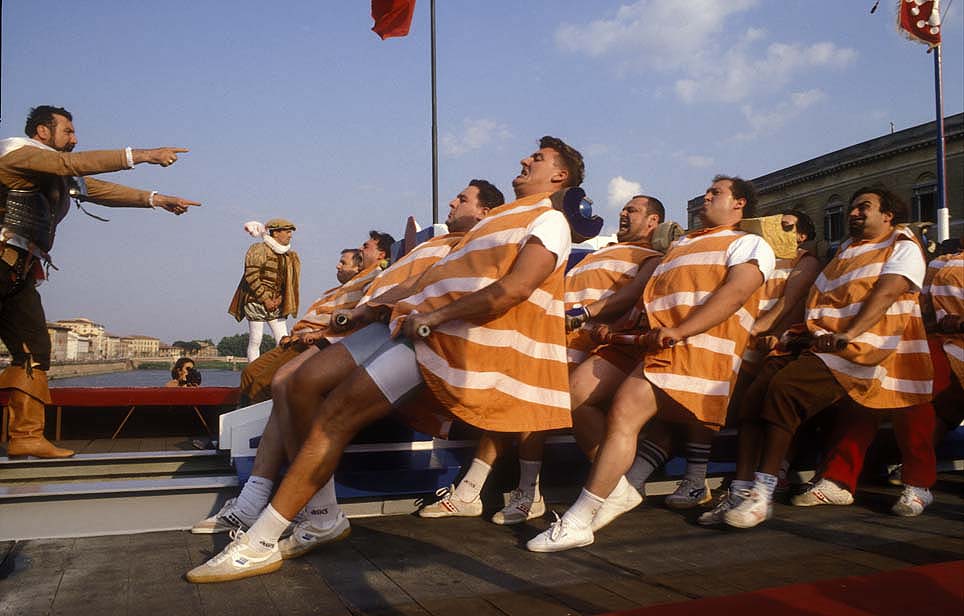
Image of the game during the battle
Gioco del Ponte

In Pisa, the Gioco del Ponte brings together the city’s two large factions, Tramontana and Mezzogiorno, in a competition involving districts, costumed participants and the public.
The event kicks off on the last Saturday in June with the Historical Parade along the Lungarni (Arno riverbanks), featuring over 700 participants dressed in costumes inspired by late 16th-century Spanish fashion.

The highlight of the event is the Battle of Ponte di Mezzo, where the teams compete against each other pushing a cart along a rail across the bridge. The faction that manages to force its opponents back to the opposite end wins.
The origins of the game are linked to Mazzascudo, which was played between the 11th and 13th centuries in what is now Piazza dei Cavalieri. The earliest documented edition of the Gioco del Ponte, however, dates back to 1568.
Revived in 1935, following a long break, the game underwent a change after the Second World War, replacing physical combat between the opposing sides with a mechanical system still used today.

1.

Giostra dell’Orso in Pistoia

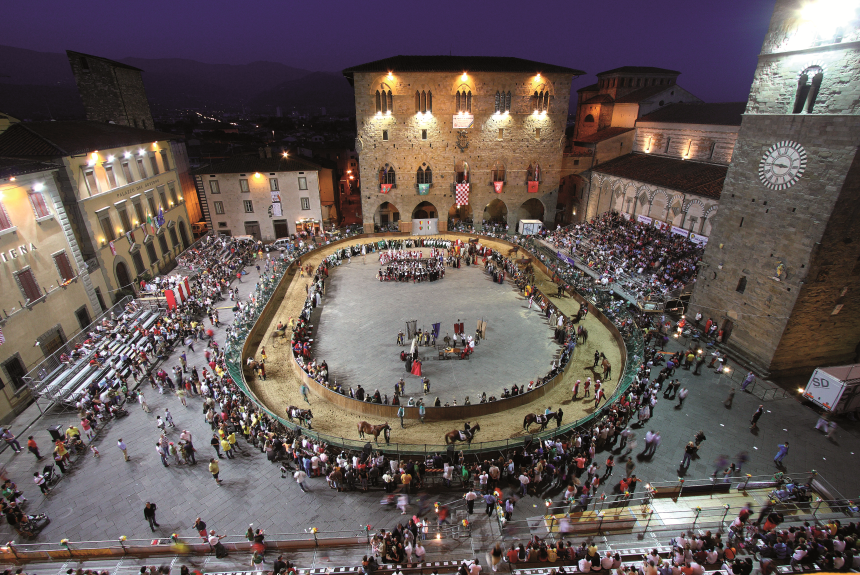
Piazza del Duomo in Pistoia, seen from above, during the Giostra dell’Orso
Joust of the Bear

On July 25 , Piazza del Duomo in Pistoia will be hosting the Giostra dell’Orso (Joust of the Bear), a modern revival of the ancient palio race documented as far back as the first half of the 13th century.
The race is preceded by a historical parade featuring about 300 participants in medieval costume, including banners, flags and representatives of the city’s four districts.
The challenge involves twelve knights - three from each district - who can be identified by the symbols of the Lion, the Deer, the Dragon and the Gryphon. 

Participants run two at a time along the course set up in the square and try to hit two bear-shaped targets with their lances.
The winning district is the one that achieves the highest score, while the best knight is awarded the title of Cavalier Speron d’Oro di Pistoia e Contado (Knight of the Golden Spur of Pistoia and its Territory.

1.

Palio della Balestra in Sansepolcro

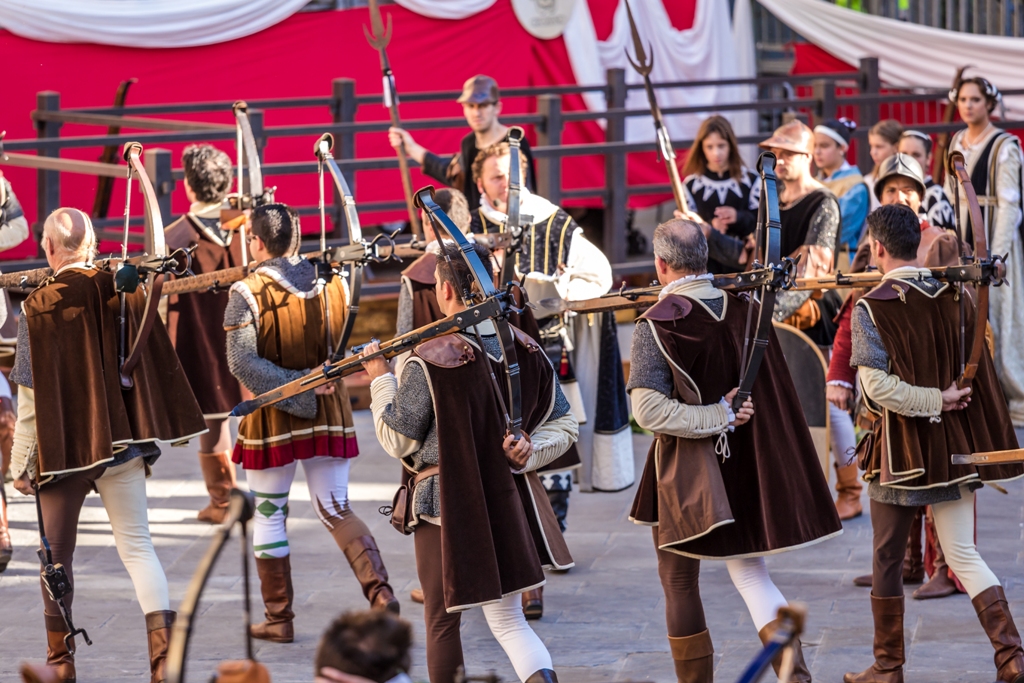
Image of the parade during the Palio
Palio della Balestra - Credit: Davide Butali

On the second Sunday in September, the Renaissance returns to Sansepolcro with the Palio della Balestra, the traditional challenge between the city’s crossbowmen and those of Gubbio.
About eighty crossbowmen take turns at the shooting benches, trying to hit the bulletta del corniolo - the smallest and most central part of the target - with their bolts. The competition has been documented since 1594, but its origins appear to date back to an even earlier period.

The reenactment starts with the arrival of the Herald and the reading of the Proclamation of Challenge.
The Palio takes place in the afternoon, followed by a parade in honor of the winner in the evening.
The program also includes the Mercato di Sant’Egidio, a reenactment of a Renaissance market in period costume, along with music and dance performances, cultural events and exhibitions by the Sansepolcro Flag-Waving Group. 

1.

Palio del Cerro in Cerreto Guidi

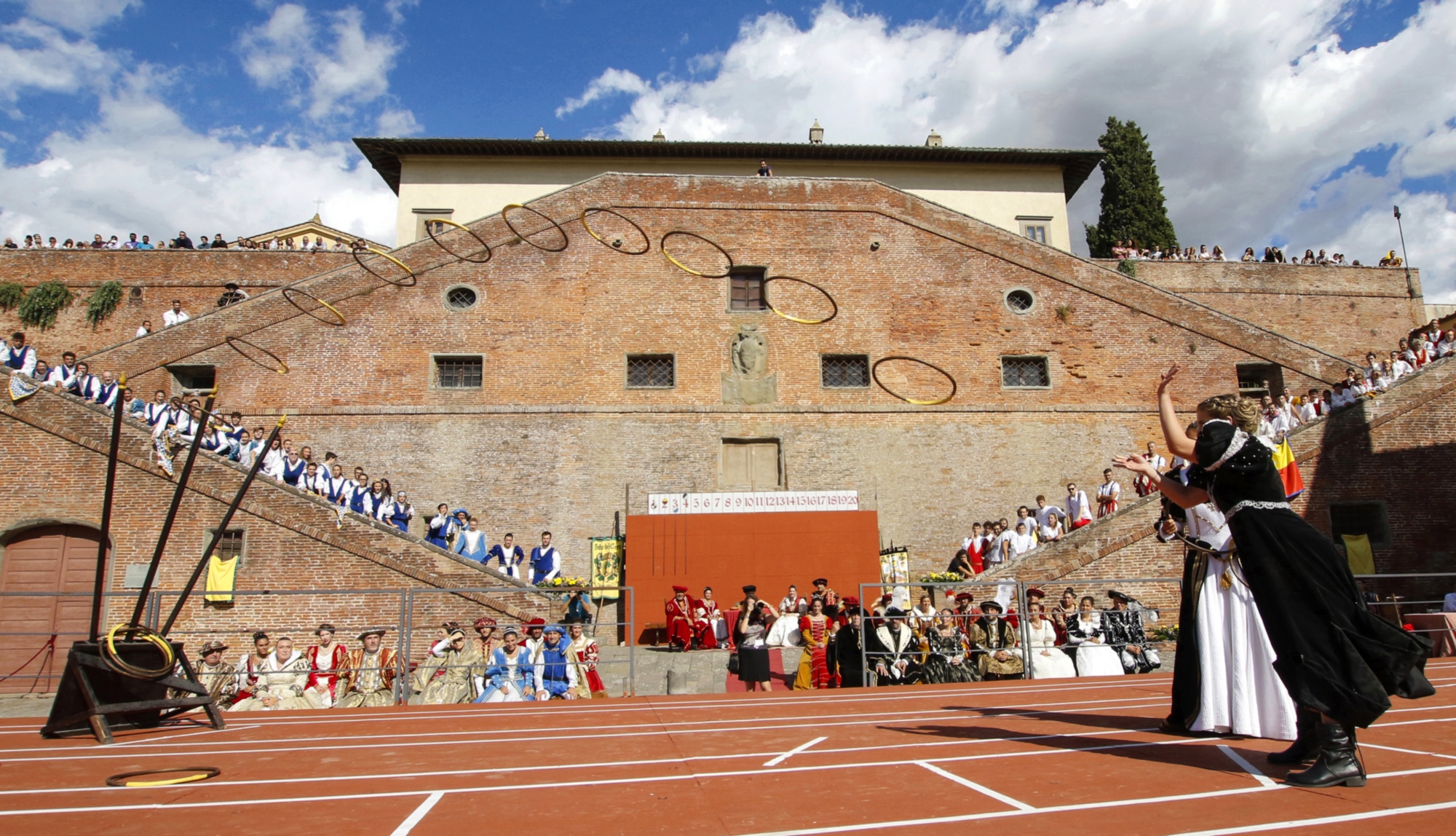
Image of the square during the reenactment, with costumed participants and games
Palio del Cerro

On the first Saturday in September, the Renaissance returns to Cerreto Guidi with the Palio del Cerro, a challenge involving the village’s four districts.

The event recreates the celebrations held in 1573 to mark the visit of Cosimo I de’ Medici. The evening begins with a costume parade through the streets of the historic center, setting the stage for the Palio contests.

The districts compete in tug-of-war, crossbow shooting, the troppoli race (on wooden blocks), the bigoncia race (in wooden wine barrels) and ring tossing.
At the end of the competitions, the winning team receives a hand-painted banner.
The festival continues the following weekend with the Palio dei Ragazzi, which features games and competitions for children.

1.

La Notte di Isabella in Cerreto Guidi

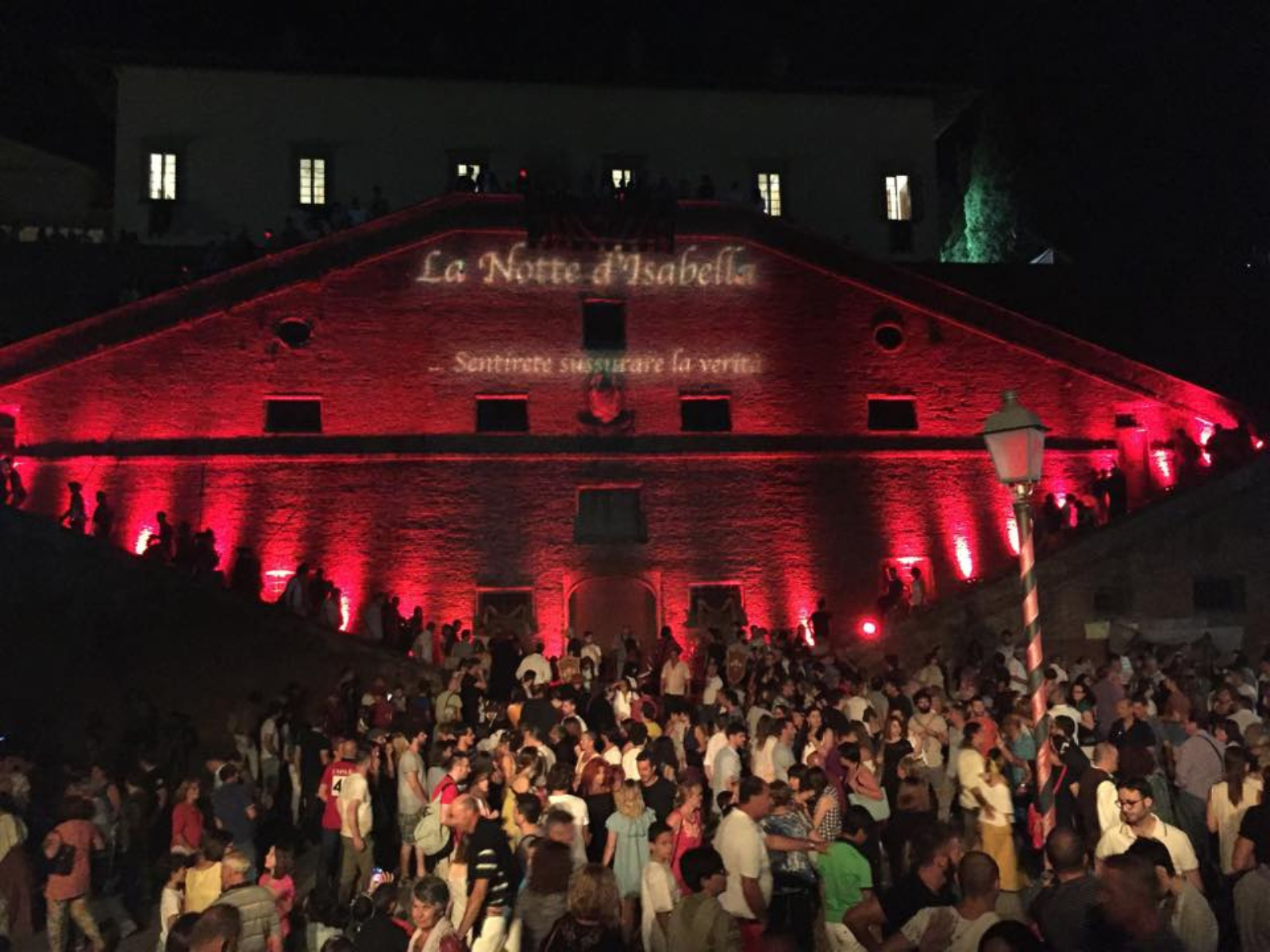
Image of the square bathed in red light and filled with people during La Notte di Isabella
la notte di Isabella

La Notte di Isabella takes Cerreto Guidi back to 1576, the year in which Isabella de’ Medici arrived at the villa to which she was particularly attached.
During the first weekend in July, the historic center becomes the setting for a grand reenactment, featuring costumed participants, ancient crafts, games, knights, musicians and dancers. The village streets come alive with sword and crossbow displays, falconry demonstrations, fire shows and flag-waving performances.

Inns and taverns serve dishes inspired by Renaissance cuisine, while historical figures accompany visitors through the Medici Villa, the Parish Church of San Leonardo and the Oratory of the Santissima Trinità.
The story retraces Isabella's final days, leading up to the news of her mysterious death, which occurred in Cerreto Guidi in July 1576.
The reenactment ends in the setting of the Medici Bridges.

1.

Monteriggioni di Torri si Corona

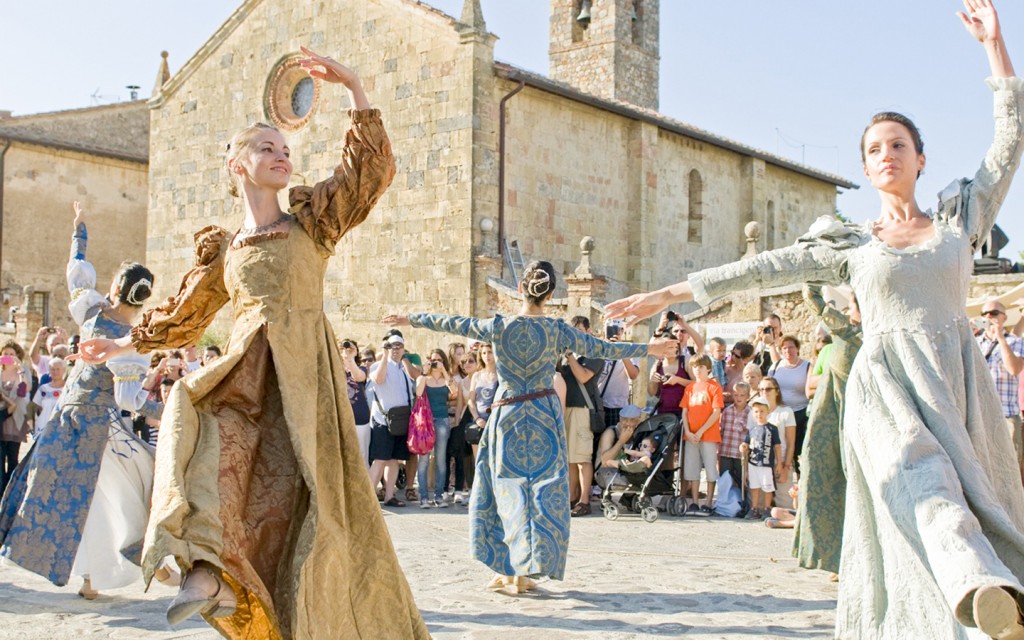
Image of costumed participants dancing in the square during the festival
Monteriggioni di Torri si Corona Medieval Festival - Credit: monteriggionimedievale.com

Also in July, Monteriggioni steps back into the Middle Ages with Monteriggioni di Torri si Corona, one of Tuscany’s longest-running historical festivals.
The event gets its name from the verses in which Dante Alighieri describes the village and its fortified boundary, formed by walls about ten meters high and fourteen towers.

Street performers, costumed participants, musicians and artisans bring the streets and squares of the castle to life with traveling shows, concerts and demonstrations of traditional crafts. The program also includes a medieval market, taverns and activities for families and children.

The festival opens with the Medieval Banquet in Piazza Alighieri, a dinner featuring period-inspired dishes, accompanied by themed performances. In the days that follow, the village hosts theater, music and performances until late in the evening.

1.

Bravìo delle Botti in Montepulciano

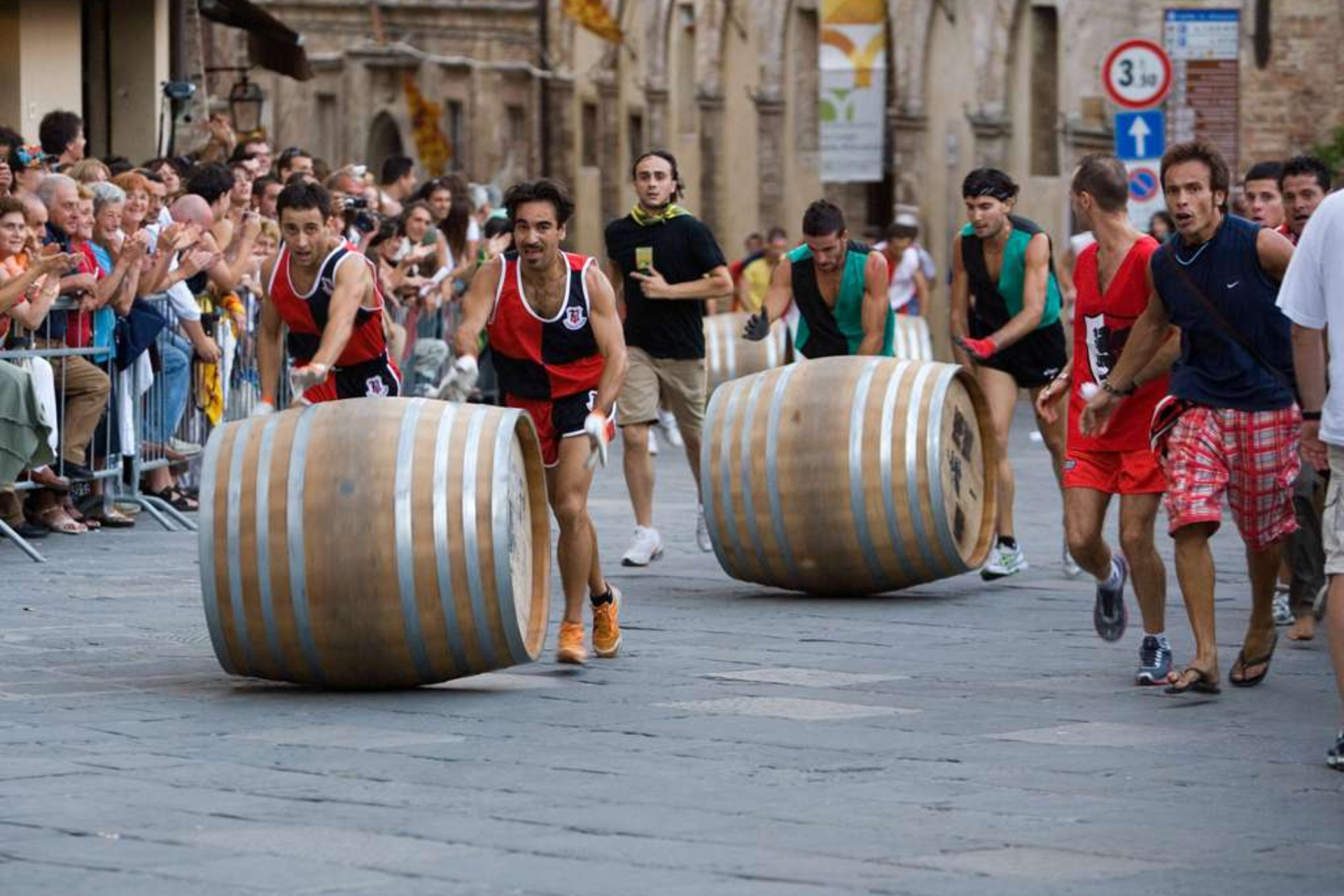
Image of the barrels rolling through the streets of the city center
Bravìo delle Botti in Montepulciano

On the last Sunday in August, the eight districts of Montepulciano compete in the Bravìo delle Botti, an uphill race along the streets of the historic center.
Cagnano, Collazzi, Coste, Gracciano, Poggiolo, San Donato, Talosa and Voltaia participate with a barrel weighing 80 kilograms. Two barrel-pushers from each district tackle a 1,800-meter course, finishing at the Cathedral churchyard in Piazza Grande.

The name Bravìo comes from the Latin term Bravium and refers to the cloth painted with the image of the Beheaded Saint John the Baptist, patron saint of the city, which is awarded to the winning district.
The race wraps up a week of events.
Sunday morning includes the drawing of the starting order, the branding of the barrels, the presentation of the Panno (painted cloth) and the offering of the votive candles.
In the afternoon, over 300 costumed participants cross the historic center in a procession, while at 7 PM, the ringing of the City Hall’s Great Bell signals the start of the race.

1.

Montopoli Medioevo

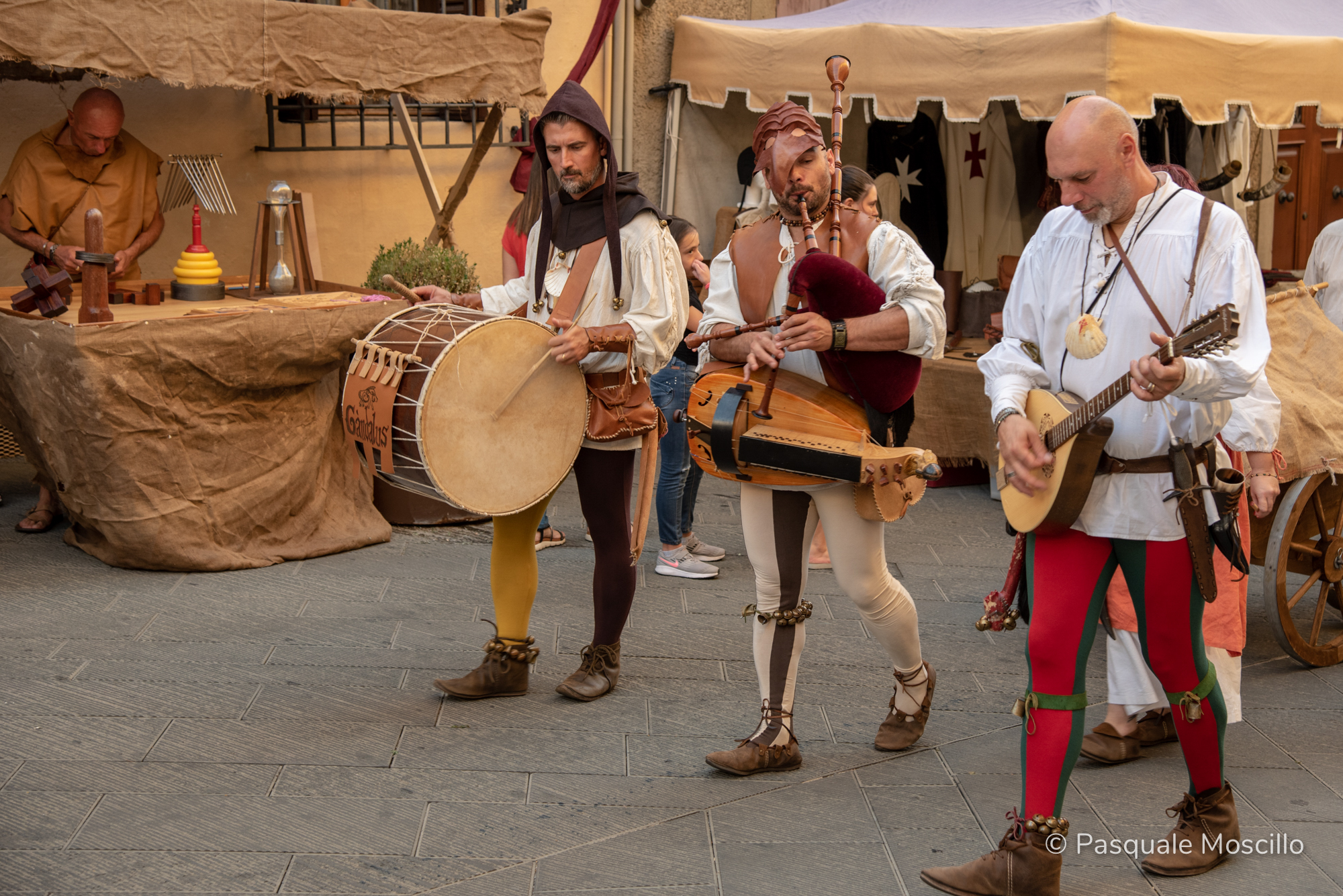
Image of musicians during the event
Montopoli Medioevo

In early September, Montopoli Medioevo takes the village of Montopoli in Val d’Arno back to the Late Middle Ages, with parades, music, challenges and scenes inspired by daily life in that period.
The reenactment is based on the division of the village, established in 1412 by Podestà Jacopo degli Albizi, into the two populations of Perinsù and Peringiù. This ancient distinction lives on in the districts of Santo Stefano, with its red and white colors, and San Giovanni, with its yellow and black colors.

For two days, more than 300 costumed participants bring the historic center to life with flag-wavers, drummers, trumpeters, street performers, archers and dancers. Costumes, weapons and crafted objects are created based on iconographic research into the period in question.
The highlight of the event is the Disfida con l’Arco (Archery Challenge), held on Sunday, when the two districts compete against each other.

1.

Cutigliano Medievale

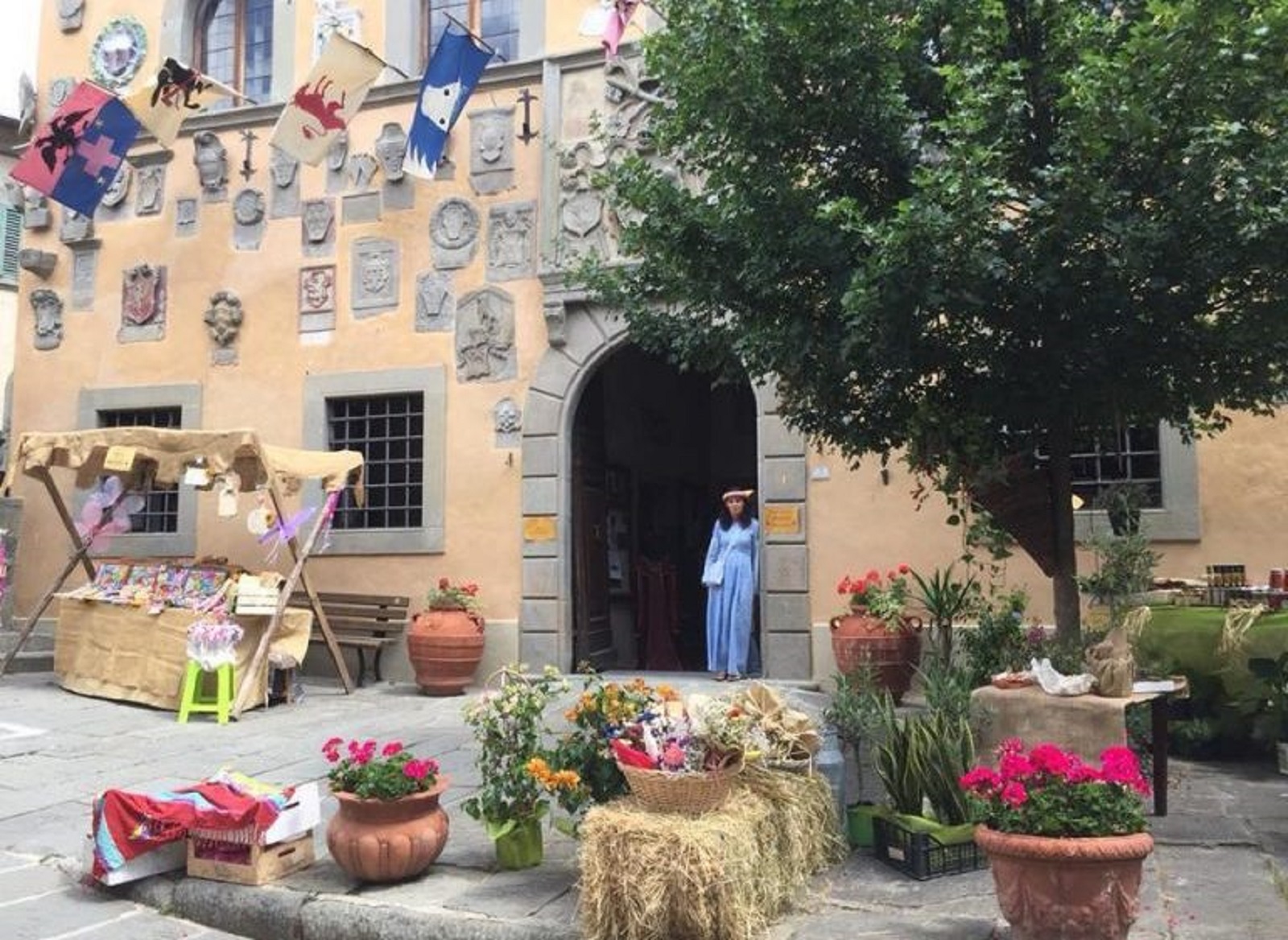
Image of a person in costume during the event in the village
Cutigliano Medievale

In July, Cutigliano Medievale takes this village in the Pistoia Mountains back in time to the atmosphere of the past, with a reenactment that involves its streets, squares and residents.
Costumed participants and parades, drummers and performances bring the historic center to life, transforming the village into a setting inspired by medieval life. 

The streets fill with characters, sounds and scenes that accompany visitors on a journey to discover local history and traditions, creating the village atmosphere as it was in centuries past.

What’s nearby?

Must-see places, stage-by-stage routes, events and tips for your trip
Events • 3 results
Ideas • 45 results
Itineraries • 15 results