Go to main content

12 designer cellars in Tuscany

Sustainable architecture that connects with the landscape

Contemporary construction, environmental sustainability and wine culture come together in 12 Tuscan wineries where the design stems from the land and follows its forms without force. 
The buildings fit into the landscape, where natural light, gravity and climatic conditions are exploited as an integral part of the production process.
In these wineries, architecture becomes a silent tool at the service of wine and the environment. The projects are part of Toscana Wine Architecture circuit that unites some of the region’s most significant signature wineries.

Contents
  • 1.
    Antinori Winery in the Chianti Classico area
  • 2.
    Il Borro
  • 3.
    Caiarossa
  • 4.
    Salcheto
  • 5.
    Petra Winery
  • 6.
    Rocca di Frassinello
  • 7.
    Tenuta Ammiraglia Frescobaldi
  • 8.
    Fonterutoli Castle
  • 9.
    ColleMassari
  • 10.
    Podere di Pomaio
  • 11.
    Fattoria delle Ripalte
  • 12.
    Sequerciani
1.

Antinori Winery in the Chianti Classico area

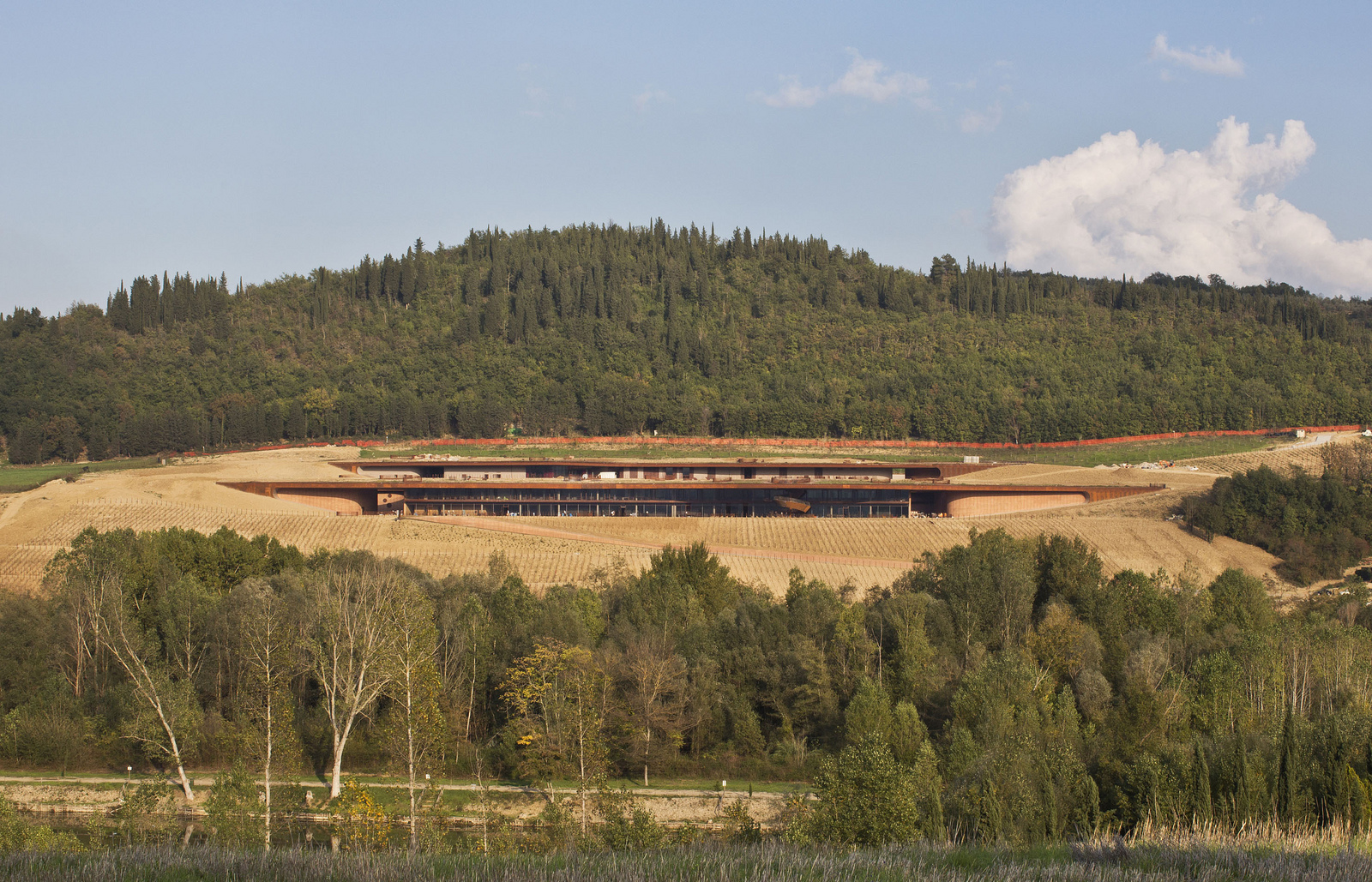
View of the Antinori Winery in the Chianti Classico area, melding into the hillside
Antinori Winery in the Chianti Classico area

Witnessing a centuries-old bond with the land, the Antinori Winery in the Chianti Classico area tells a story that began in 1385, seeing winemaking tradition and architectural innovation coexist in balance.

Opened in 2012 and designed by Archea Associati, the winery is almost invisible in the landscape, embedded in the hillside where the roof perfectly follows the natural profile and is planted with vines.
From the exterior, the building is revealed only through two horizontal slits, which let in light and open up to glimpses of the Chianti region.
The choice of hypogeal architecture allows for the use of natural soil conditions for climate control, reducing environmental impact and energy consumption.
The production process also follows a natural principle, involving winemaking by gravity, from the arrival of the grapes to the underground barrique cellar, accompanying the wine along a path consistent with the morphology of the site.

1.

Il Borro

The long underground tunnel that connects the village to the historic winery
The winery - Credit: Michela Simoncini

The origins of the village of Il Borro go back to the Tuscan Middle Ages and the vicissitudes of the families that have marked its history. Nestled in an area rich in art and culture between Florence, Arezzo and Siena, Il Borro retains a strong link with the past. Over the centuries, the Medici, the Savoy and, since 1993, the Ferragamo families have protected its identity, preserving its charm and transforming the estate into an environmentally-conscious oasis, entirely organic since 2015.

The property lies in the heart of Valdarno, amid pristine forests and rolling hills. In this context is the winery designed by architect Elio Lazzerini, conceived as a natural continuation of the medieval village and the rural landscape in the surrounds.
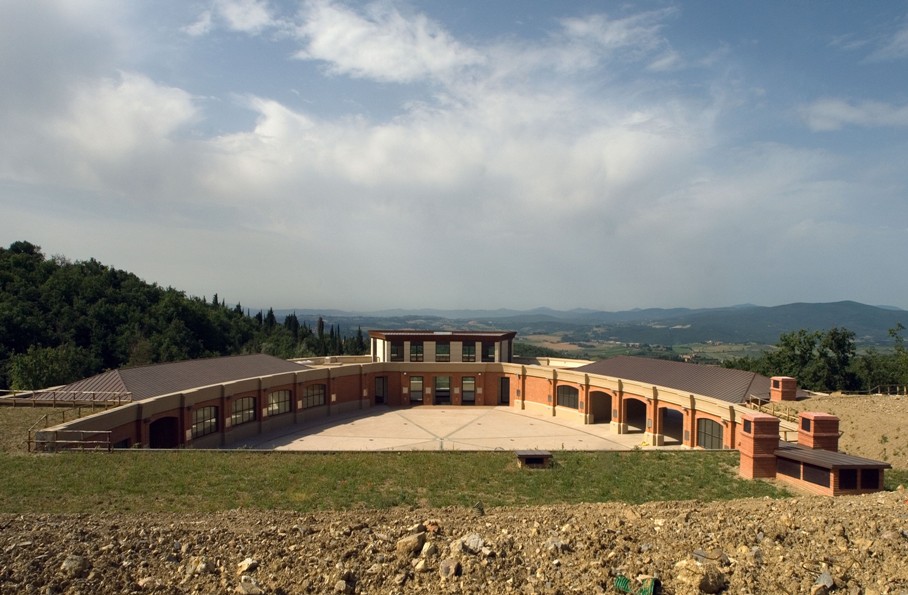
Constructed in 2004, the winery is a brick building with a traditional layout, partly underground to visually and functionally dialogue with the old farmhouse.
The materials are reminiscent of local rural architecture, while the curvilinear layout helps reduce the visual impact of the complex
A long underground tunnel connects it to the historic underground cellar, now used for wine ageing and tastings.

1.

Caiarossa

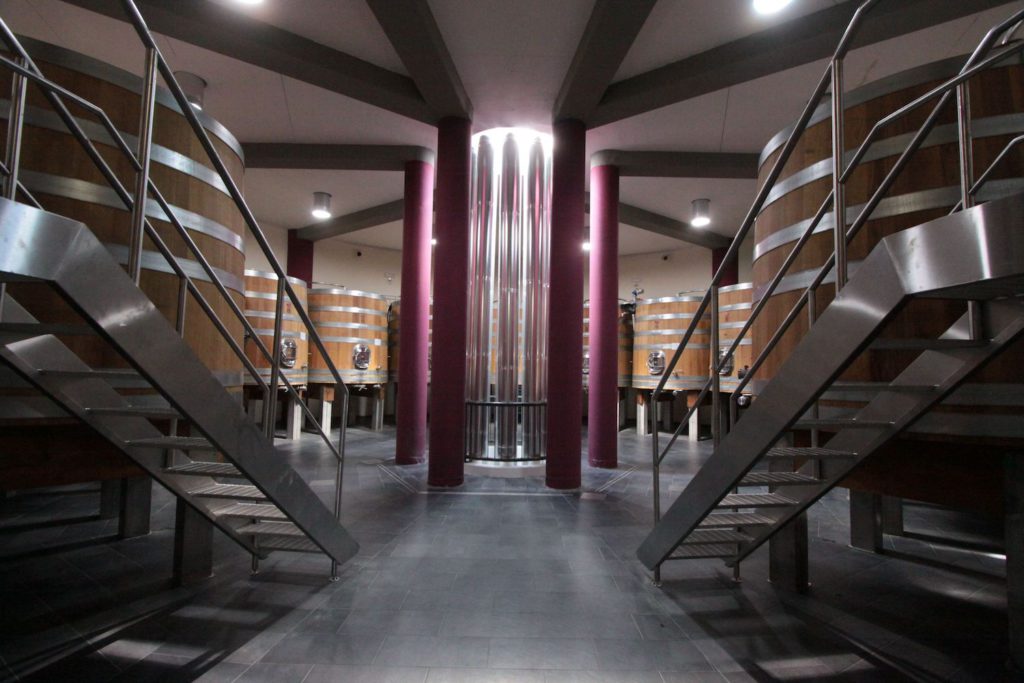
The interior of the cellar
Caiarossa - Credit: Cantina Caiarossa

The Cantina Caiarossa is located among the vineyards of Riparbella, a quaint medieval village on the slopes of a hill overlooking the Etruscan Coast. An agricultural and natural setting that immediately defines the winery’s identity.
The history of Caiarossa began in 1998 with a clear choice: to adopt the principles of biodynamic agriculture as the basis for cultivating the vines. 
The estate covers some 173 acres or 70 hectares, just over half of which are occupied by vineyards organized in a mosaic of 11 varieties, selected to best interpret the complexity and diversity of the soils.
The name itself, Caiarossa, recalls the intense red (rossa) color of the soils that characterize the property.
Built in 2001 and designed by architect Isabella Monteforte, the winery is inspired by the principles of geo-biological architecture and Feng Shui, which guided its forms, orientation and materials.
Set into the natural slope of the hillside, it is structured according to a gravity-based production cycle. The grapes are introduced from above and naturally accompanied through the winemaking and maturating stages to the underground area designated for aging, where the temperature and humidity remain constant.

1.

Salcheto

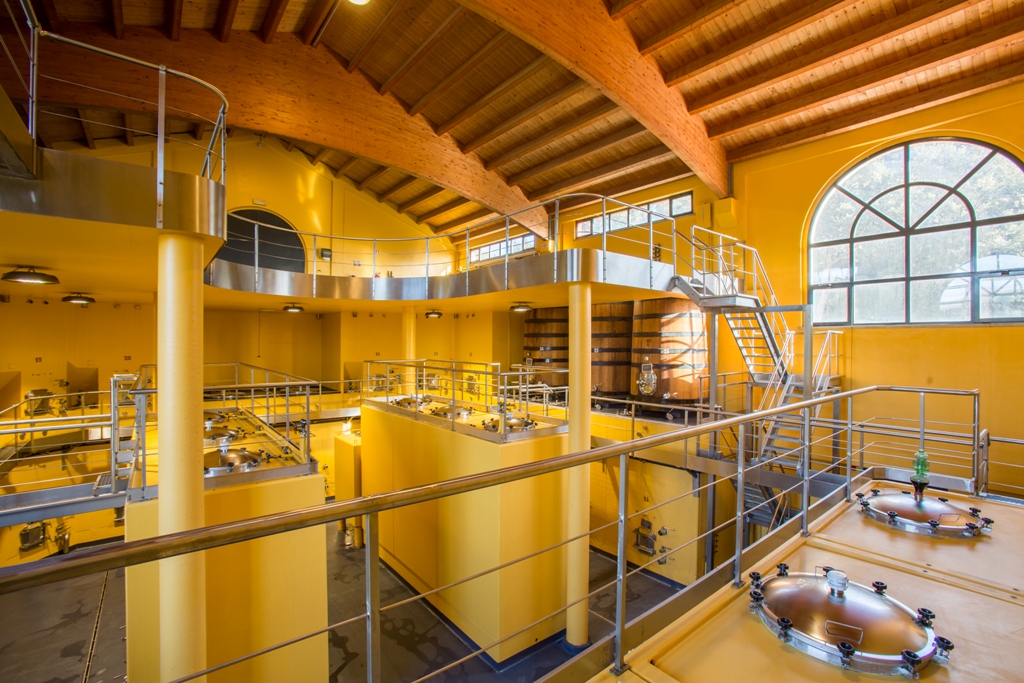
Interior of the Salcheto Winery
Salcheto - Credit: Cantina Salcheto

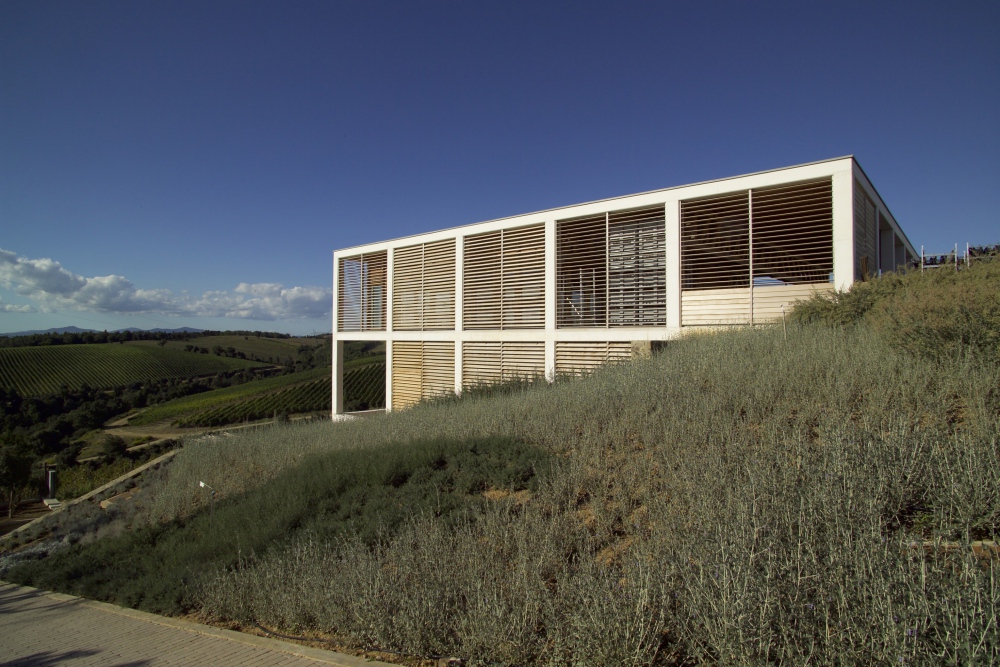
The Salcheto Winery overlooks the panorama of Montepulciano, in the heart of Vino Nobile territory.
Led by Michele Manelli, it combines an advanced manufacturing vision with strong ties to the local context.
The architecture of the winery, with its simple lines and markedly contemporary character, reflects an approach geared toward experimentation and sustainability, while the wines are created with the aim of authentically interpreting the terroir. 
The winery is conceived as an open and accessible place. Most of the spaces can be visited to see up close the different stages of daily operations, from production to refinement.

1.

Petra Winery

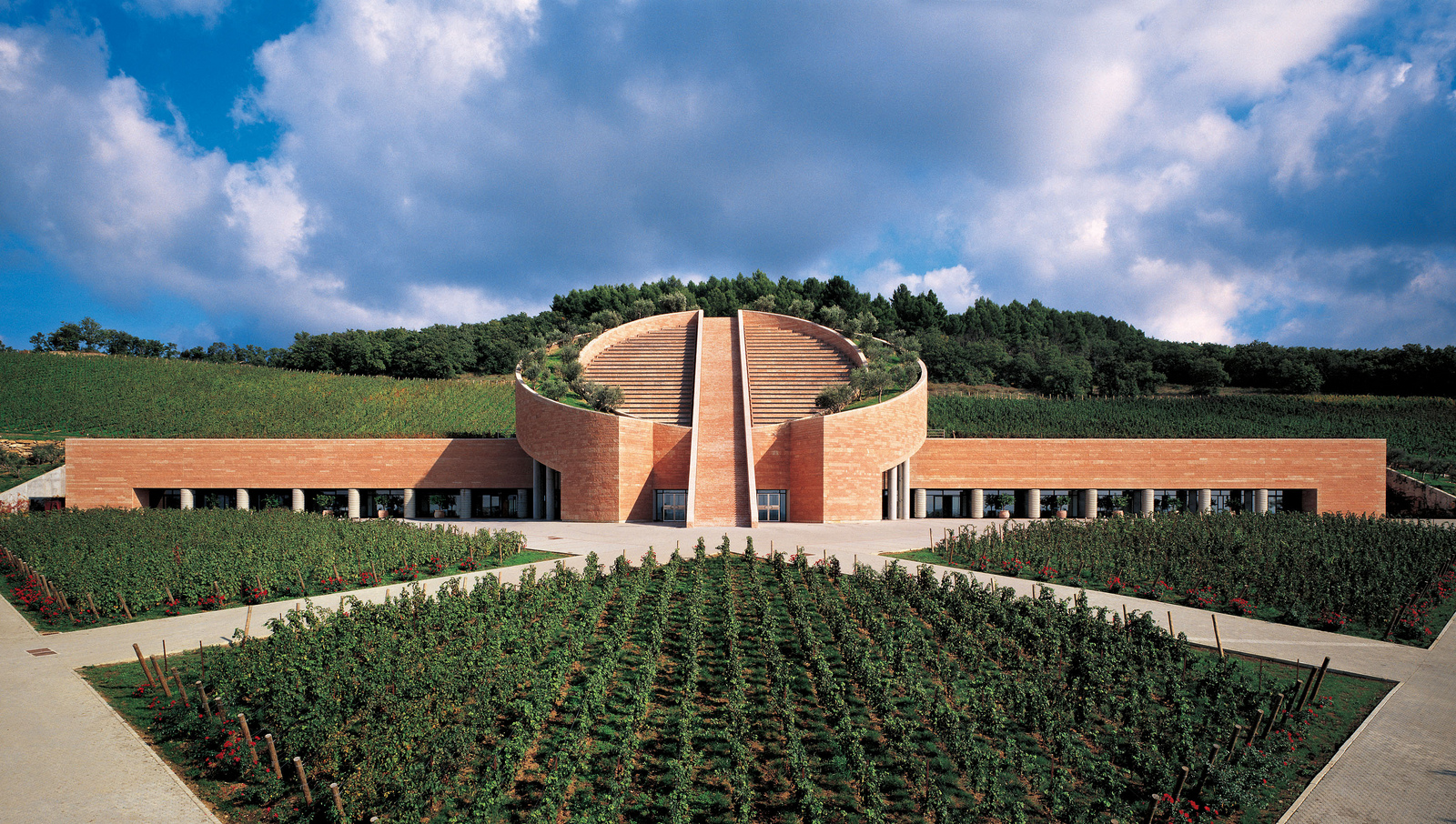
Exterior view of the Petra Winery in Suvereto
Petra Winery

Designed by architect Mario Botta, the Petra Winery is located in Suvereto, at the heart of the Etruscan Coast, and is conceived as an integral part of the surrounding hillside.
The estate is set in a broad natural context between Metallifere Hills, Montioni Park, Poggio Tre Cancelli Reserve and Sterpaia Park, where the relationship between architecture and environment is central.
The building is carved into the hillside and almost invisible from the outside—a choice that reduces visual impact and allows the natural ground conditions to be exploited.

At the heart of the facility are the maturation tunnels, destined for barrels and bottles, crossed by a long gallery that leads up to an exposed rock face, marking the end point of the production route.
A distinctive feature of the project is the large cylindrical volume that structures the entire building and houses the entrance and winemaking stages. 
Around this axis, natural light punctuates the interior spaces and accompanies you through an experience interwining technology, landscape and sensory perception, making architecture an active part of the territory’s narrative.

1.

Rocca di Frassinello

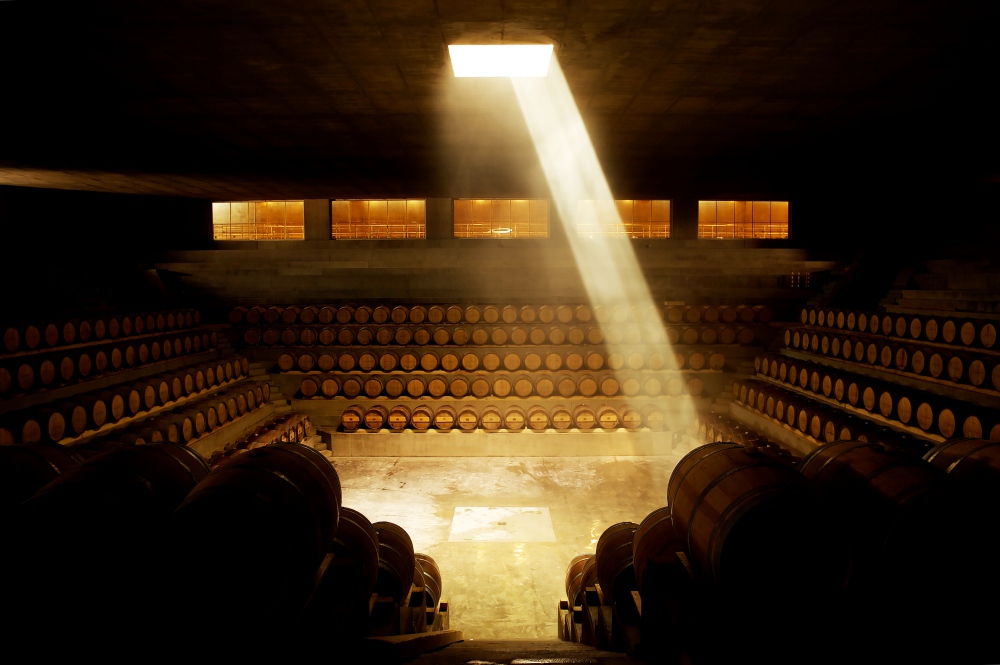
Rocca di Frassinello’s barrique cellar, where the function of natural light is evident
The barrique cellar - Rocca di Frassinello

Rocca di Frassinello in Gavorrano is the winery designed by Renzo Piano to blend perfectly into the hilly landscape of the Maremma.
Realized in 2007 as part of a collaboration between Castellare di Castellina and Domaines Barons de Rothschild – Château Lafite, the structure is conceived as an fundamental production organism, modeled on the natural morphology of the land and designed to accompany but not dominate the agricultural context.

The building is structured according to a gravity winemaking cycle where the grapes naturally flow through the various processing stages, reducing mechanical intervention and energy consumption.
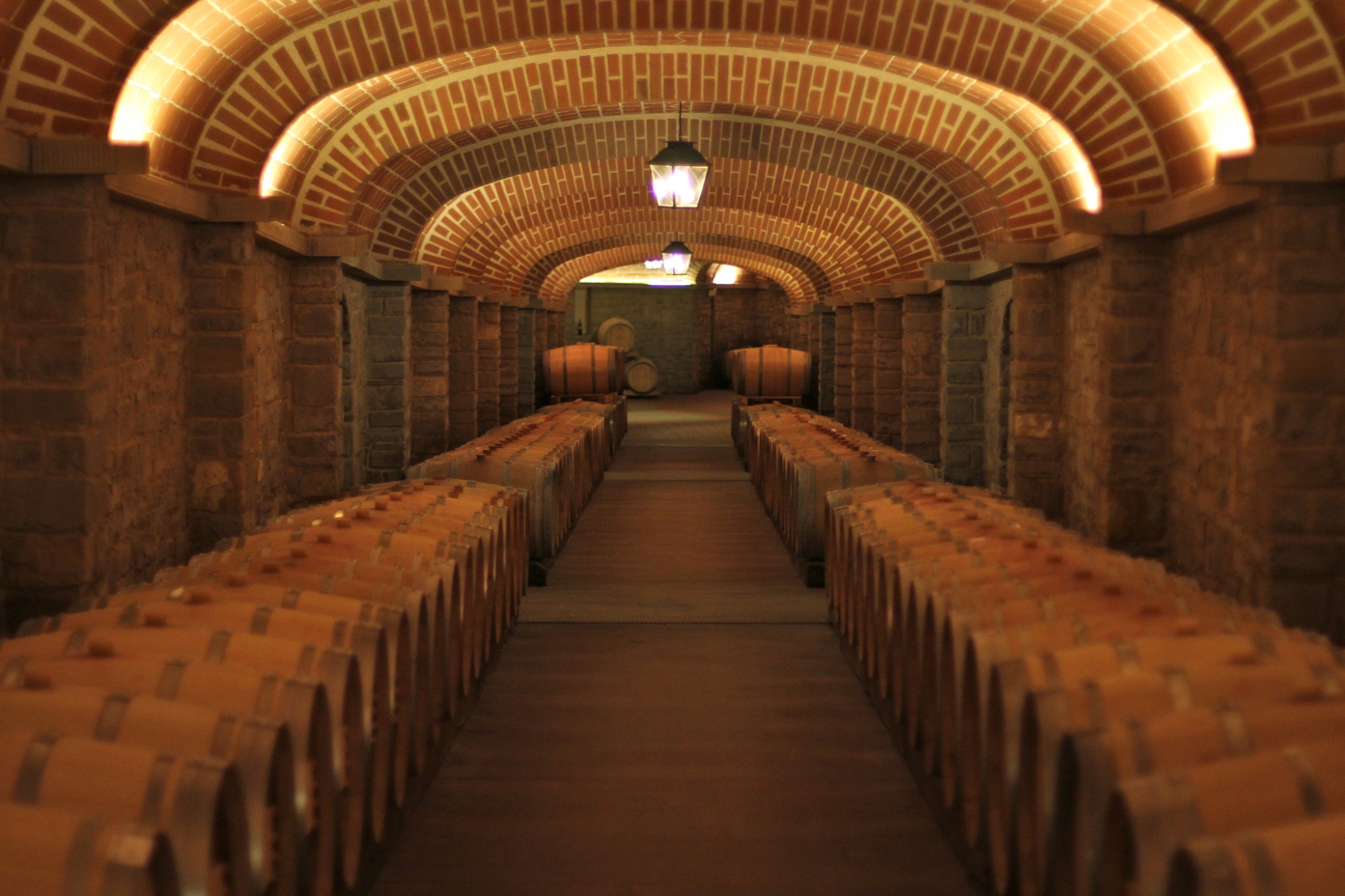
The tower that pinpoints the hill has a precise function: to capture and entice light into the barrique cellar dug into the rock, at some 165 feet or 50 meters deep, where the inertia of the soil ensures stable conditions for aging the wine.

Tenuta Ammiraglia Frescobaldi

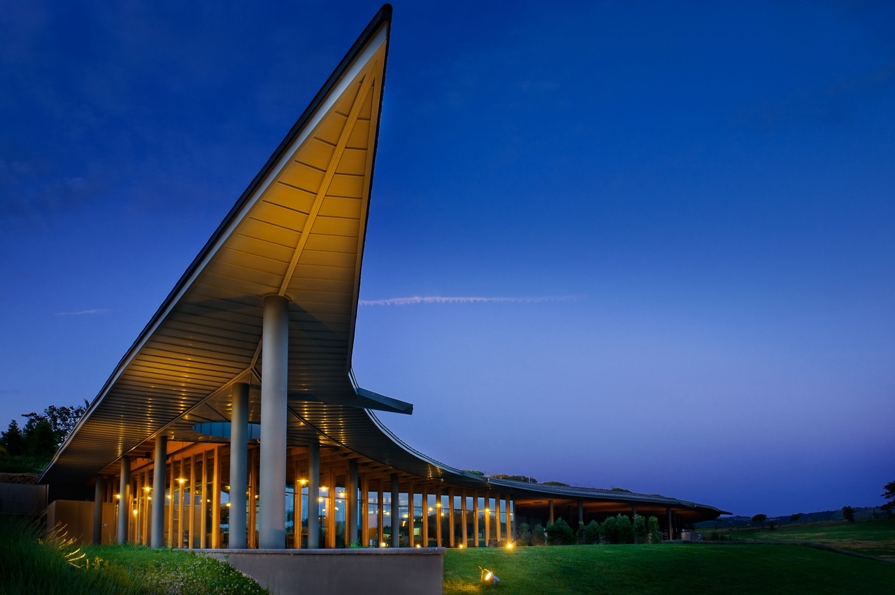
The unmistakable structure of the Cantina Ammiraglia
Ammiraglia Frescobaldi Winery

In the heart of Maremma, within hills open to the sea and a landscape marked by light and wind, Tenuta Ammiraglia tells of a contemporary Tuscany, projected toward new horizons. 
It is here that the Frescobaldi family has chosen to invest in a warm and bright territory, mitigated by sea breezes, resulting in wines that express freshness, minerality and a strong territorial identity.

Designed in 2006 by architects Piero Sartogo and Nathalie Grenon, the winery aligns with the natural slope of the hill as a light and dynamic emblem, an elongated structure that elegantly recalls the prow of a ship facing the sea.
The building emerges from the ground through a thin slit, letting greenery and vegetation cover most of its volumes in continuous dialog with the surrounding landscape.
Designed first and foremost as a workplace, the winery combines technological innovation and environmental efficiency.
The decision to have the production cycle run across a single level, with grapes arriving from above and vinification by gravity, reduces energy consumption and limits invasive mechanical operations, while ensuring optimal conditions for wine quality. 

Fonterutoli Castle

Exterior of the Fonterutoli Winery
Fonterutoli Winery

Overlooking the Chianti hills with views over Siena, Cantina di Fonterutoli represents a point of balance between historical continuity and contemporary vision.
Owned by the Mazzei family since 1435, the estate is the result of a profound knowledge of the land, matured over centuries of work and refined by more than 50 years of research into the Sangiovese wine grape variety.

The heart of the winery, designed in 2008 by Agnese Mazzei, runs deep.
The architecture, which is largely hypogeal, reduces visual impact and takes advantage of natural underground conditions for thermal control, limiting energy consumption.
Being vertically structured across several levels allows the production cycle to be carried out by gravity.
A distinctive element of the project is the focus on micro-vinification. 

ColleMassari

Exterior view of the ColleMassari Winery
ColleMassari Winery

At the foot of Monte Amiata, in the territory of Cinigiano, the ColleMassari Winery discreetly fits into the landscape of DOC Montecucco, an area characterized by a microclimate particularly favorable to viticulture. 
The estate takes its name from the ancient ColleMassari Castle, whose origins date back to the 14ᵗʰ century, when it served as a fortified granary for the territory. 

The winemaking cellar, completed in 2003 to a design by architect Edoardo Milesi, is conceived according to the principles of bioarchitecture and mainly unfurling within the hillside. 
Indeed, the production, storage and technical areas are located in a below-ground volume, exploiting the thermal inertia of the terrain to ensure stable environmental conditions and reduce energy consumption.
More than a building in the traditional sense, the winery is configured as a sequence of open and covered spaces designed to accompany agricultural activities without imposing on the landscape.

Podere di Pomaio

Exterior of the Podere Pomaio Winery
Podere di Pomaio

Podere di Pomaio is a winery that speaks a contemporary language, deeply rooted in the history and memory of the territory surrounding Arezzo.
The name itself recalls an ancient origin: Pomarium, a place of fruits, evoking a primary relationship with the land and the cultivated landscape.

The winery stands on the hills overlooking the city, about 1640 feet or 500 meters above sea level, along the ancient route of the Etruscan aqueduct.
Built in 2009 to a design by architect Marisa Lo Cigno, the winery was constructed with large blocks of sandstone, a material of ancient origin that becomes a structural and symbolic part of the building. 
Worked with high-porosity natural mortars, the masonry does not inhibit the natural transpiration of the environments, promoting temperature and humidity regulation without resorting to energy-intensive systems.
Natural materials such as stone, wood and lime dialog with lightweight metal roofing that protects the building and creates generous porches, helping to limit overheating in summer.

Fattoria delle Ripalte

Exterior view of the winery
Fattoria delle Ripalte

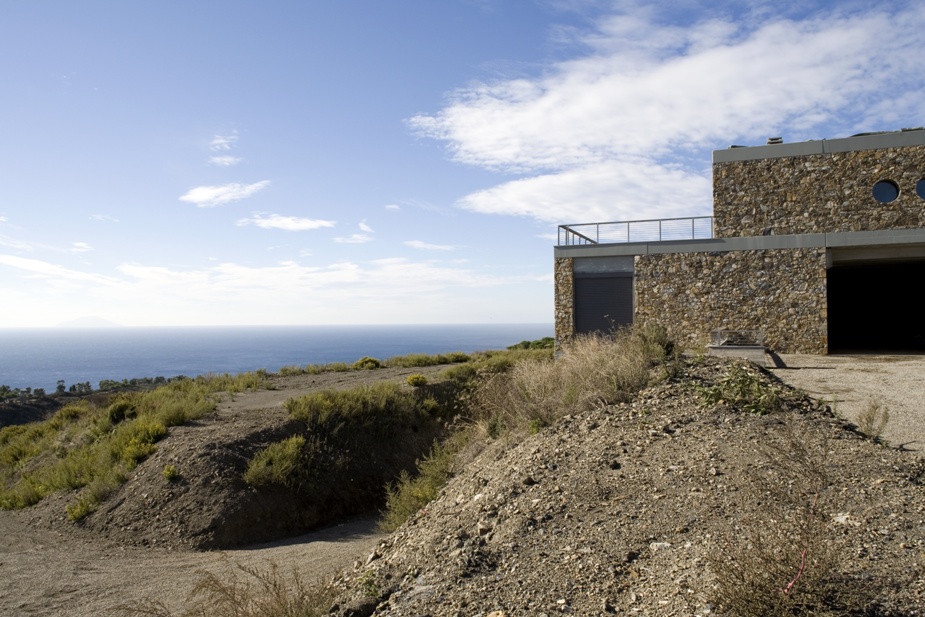
At the southern end of Elba Island, overlooking one of the wildest stretches of the Tuscan Archipelago, Fattoria delle Ripalte is home to a winery designed by Tobia Scarpa, perfectly integrated into the landscape of Mediterranean scrub, sea and terraced vineyards.

The estate was established in 1896 and today covers about 1110 acres (450 hectares), entirely within the Tuscan Archipelago National Park
In this context, vineyards are located in the most favorable positions in stony and strongly draining soils, often terraced. 
A choice that prioritizes quality over quantity, reflected in a limited, strongly identity-based production.
Leaning against a hillside previously scarred by mining activities, the facility takes advantage of a once compromised area, minimizing its impact on the surrounding pristine landscape
The transfer of grapes and wine occurs by gravity, naturally accompanying the various stages of the production process.
On the roof, a large terrace is set aside for drying grapes in a space that embraces the vineyards, the Elban coast and the entire archipelago.

Sequerciani

In the hilly landscape of Maremma, in the village of Tatti, the Sequerciani Winery fits in with an almost imperceptible presence, choosing the path of underground architecture as a means of dialogue with the land.

The project, signed by Swiss architect Sergio Cavero, stems from a specific idea: to minimize visual and environmental impact, letting the earth itself determine the building’s form, climate and operation.
The cellar is carved into the hillside and organized around a simple geometry.
A circular volume houses the fermentation room, the productive heart of the space, connected to a curvilinear underground path that passes through the different stages of the work.
The depth ensures naturally stable microclimatic conditions, being essential for winemaking and aging, limiting the use of artificial temperature and humidity control systems.
Environmentally, the project integrates passive solutions: exploitation of soil thermal inertia, rainwater harvesting and a reduction of energy consumption. 

What’s nearby?

Must-see places, stage-by-stage routes, events and tips for your trip
Events • 4 results
Ideas • 87 results
Itineraries • 37 results
Travelogs • 5 results