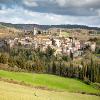
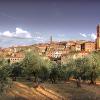
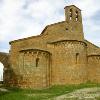
Rigomagno is a hamlet in the municipality of Sinalunga, located atop a hill in the Valdichiana Senese.
Likely of Roman origin and documented from the 11ᵗʰ century onward, it began as a single castle then later become a fortified village. Initially placed not far from the Foenna stream, to which the Latin term rigum magnum (meaning “big stream”) likely refers, this quaint village was later moved higher for reasons of salubrity.
The village served as a strategic location during the time of the Republic of Siena. On August 16, 1281, the countryside around the castle was the setting of a battle between the Guelph troops and the rebellious Ghibellines who had recently occupied Rigomagno after an extensive siege. After this battle, Siena ordered it to be razed to the ground.
Some years later and just several hundred feet from the old castle, the present walled village was built, one of the clearest testimonies to the construction criteria of 13ᵗʰ-century Sienese urban centers. The village then passed into the hands of the Florentine Medici family in 1552, when it was decided to tear down most of the walls. Rigomagno has not changed much since then, except for the installation of the Torre dell’Acqua (cistern) in the early 20ᵗʰ century.
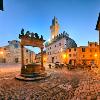
Despite transformations over time, the 14ᵗʰ-century wall layout based on three parallel streets in a longitudinal direction and one crosscutting street is still legible today, so that exactly at the central intersection are the Palazzo Pretorio with its tower, the Church of San Marcellino and the Torre dell’Acqua, being the main buildings of Rigomagno.
Traces of the walls are still clearly recognizable today. In several places, you can make out just the base while there is also a good stretch that is more intact along the northern front, encompassing two semicircular towers. On the opposite side of the village, on the south front, stands the Compagnia di Santa Croce Church.